Children have a natural need to discover the world around them. They do this through all their senses and movements, which is why they need to participate in activities to learn. This is called 'active learning'. How can you support this curiosity and need to move at home?
At any age, but especially when we are young, we learn best when we are involved in meaningful experiences that engage multiple senses and our emotions. It is through language and conversation that adults help children gather information from all their senses and connect it with past learning.
Children are constantly experimenting. You've probably seen them open a toy by throwing all the pieces on the floor to understand what's inside the box, looking, touching, and listening to sounds. As adults, we tend to forget this. Freedom of exploration and movement is essential: 'Children learn by experiencing their world using all their senses. Restricting movement, especially at a young age, hinders the process of learning through experience.'
Encourage their natural interests. If they love music, listen to it often, play instruments together, and dance together. If they like insects, give them a bucket and a net and go look for them in a park. Find books about insects and read them to them.
Go for walks outside and wonder aloud about trees, the sky, and stars. Also, let your child see you pursuing your own interests.
The question 'Where do babies come from?' won't have the same answer if your child is three or thirteen. At any age, ask them what they think before you answer. And if you don't know the answer, say so. What a great opportunity to show them that we can always learn, and take the chance to show them how, by looking for a book at the library, for example.
Books are windows to all sorts of worlds, delighting curious minds. Young children exposed to books become better readers. Let your child choose their own books; the important thing is that they are captivated so that reading becomes a habit and a pleasure. Paris is full of other outings to delight your child: toy libraries, the Cité des enfants at La Villette, and theaters. The magazine Paris Môme4 lists monthly outings for children in the city.
If your toddler is exploring houseplants, put them out of reach, but offer a similar alternative (a trip to the park to look at soil and plants, or a small bowl of soil they can touch, smell, play with, and inspect). Explain what you are doing and why; this will teach them important problem-solving techniques, as well as creative and acceptable ways to explore the world.
Unlike some toys designed to be used in a specific way, materials like boxes, blocks, water, sand, and pots can be used imaginatively. Don't tell your child what to do with the materials, how to do it, or what the end result should look like. Let your child's curiosity be their guide.
As often as possible, go outside with your child. They need to expend energy and explore the world with their whole body. Take advantage of parks, as contact with nature is also very beneficial for their development.
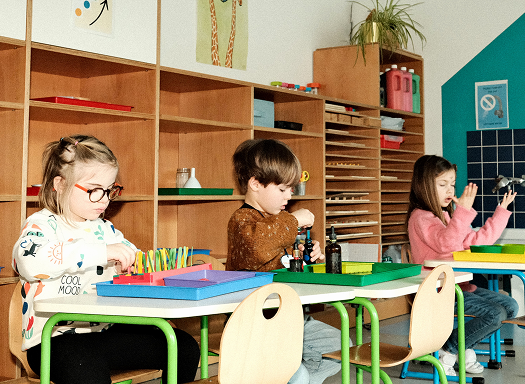
In our classrooms, children are very often on the move. While this might give the impression of a "lack of structure," it is actually a deliberate and carefully planned approach.
Children move to gather the materials they need for an activity, to find a comfortable position, to wash a paintbrush, or to ask a question. Their games and activities naturally involve movement, and their bodies are just as important a learning tool as their brains!
Scientific research has repeatedly shown that children need opportunities to move in the classroom. Therefore, we have organized our classes and planned our daily activities with this in mind.